
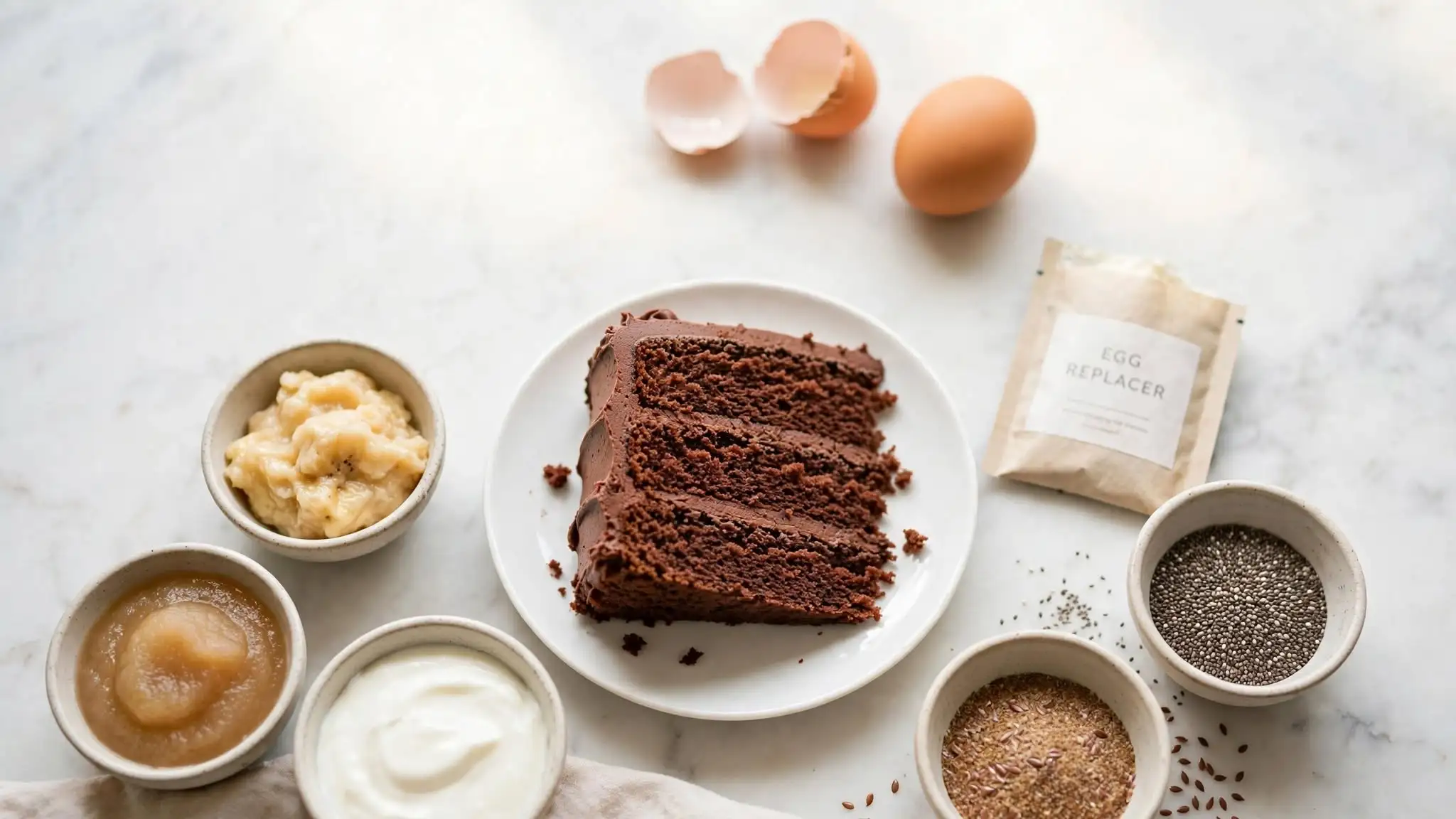
Egg Substitutes in Cake
Eggs do several jobs in a cake at once: they add moisture, bind ingredients, support structure, emulsify fat and liquid, and help create lift. That is why there is no single perfect egg replacement for cake—the best substitute depends on the cake type, the number of eggs, and whether you need an egg-free or vegan option.
This guide compares common substitutes, gives practical starting ratios, and explains how to troubleshoot dense, gummy, dry, or crumbly egg-free cakes. Treat every ratio as a starting point: cakes with several eggs, separated eggs, or whipped egg whites usually need more adjustment than a simple one-egg swap.
What Do Eggs Do in Cake?
Eggs are multi-function ingredients. Yolks add richness, color, and emulsification; whites add proteins that set during baking and can trap air for lift. Together, they help create a cake that is moist without being wet and tender without falling apart.
Eggs contribute to cake in five main ways:
- Moisture: Eggs contain water that hydrates flour, sugar, and other dry ingredients.
- Binding: Egg proteins help hold the batter together as it bakes, reducing crumbling.
- Structure: As eggs heat, their proteins coagulate and become part of the cake’s internal framework.
- Emulsification: Lecithin in egg yolks helps fat and water-based ingredients blend more evenly, supporting a smoother batter and more uniform crumb.
- Leavening and lift: Eggs trap air during mixing; whipped egg whites are especially important in sponge, chiffon, and angel food cakes.
Because eggs provide both moisture and structure, adding extra liquid or fruit purée can make a cake soft but unstable. A good egg replacement should address the main job the egg was doing in that specific recipe.
Best Egg Substitutes in Cake
The options below are most useful for replacing one or two whole eggs in butter cakes, oil cakes, muffin-style cakes, and many quick cakes. For recipes that rely on whipped egg whites—such as sponge, chiffon, or angel food cake—none of these simple swaps reliably recreates the same lift.
Unsweetened Applesauce
Starting ratio: 1/4 cup unsweetened applesauce per egg.
Applesauce instead of eggs in cake adds moisture and mild sweetness. It works especially well in chocolate cake, spice cake, carrot cake, and muffin-style cakes. Choose unsweetened applesauce so you can control the sugar level, and reduce another liquid slightly if the batter becomes too thin.
Applesauce adds moisture but little protein or structure, so the cake may be more tender and dense than the original. It is generally better for moist, casual cakes than for light sponge cakes.
Mashed Banana
Starting ratio: 1/4 cup mashed ripe banana per egg.
Mashed banana adds moisture, binding, and sweetness. It is a strong choice for banana cake, chocolate cake, spice cake, and hearty muffin-style cakes.
Banana adds a noticeable flavor, so avoid it when you want a clean vanilla, lemon, or almond cake. Use very ripe banana for easier mashing, but expect a denser, moister crumb than an egg-based cake.
Yogurt
Starting ratio: 1/4 cup plain yogurt per egg.
Plain yogurt adds moisture, tenderness, and a slight tang. It can work well in chocolate cake, coffee cake, and pound-cake-style batters, especially when the recipe already includes enough baking powder or baking soda for lift.
Regular dairy yogurt is egg-free but not vegan. For a vegan cake, use an unsweetened, relatively thick plant-based yogurt instead.
Flax Egg
Starting ratio: Mix 1 tablespoon ground flaxseed with 3 tablespoons water. Rest for 5–15 minutes, until thickened, then use it in place of one egg.
A flax egg for cake is a popular vegan egg substitute for baking. Ground flaxseed absorbs water and forms a gel that helps bind the batter. It has a mild, slightly nutty flavor and works well in chocolate, spice, banana, carrot, and rustic cakes.
Flax eggs provide binding rather than the aeration of whipped egg whites, so they are not ideal for angel food cake or classic sponge cake. Use finely ground flaxseed meal for the smoothest texture.
Chia Egg
Starting ratio: Mix 1 tablespoon chia seeds with 3 tablespoons water. Rest for 5–15 minutes, until gelled, then use it in place of one egg.
A chia egg behaves similarly to a flax egg, though whole chia seeds can leave small specks in the crumb. It is useful for chocolate, spice, and fruit-based cakes where a little texture is welcome.
For a smoother appearance, grind the chia seeds before hydrating them. Like flax, chia improves binding but does not replace the lift from whipped egg whites.
Commercial Egg Replacer
Starting ratio: Follow the package directions for the number of eggs being replaced.
Commercial egg replacers are formulated to mimic some of eggs’ binding and structural functions. They are often a dependable choice when you need a neutral-flavored egg-free cake, particularly vanilla, yellow, or white cake.
Always follow the specific brand’s instructions. Products differ in mixing ratio, hydration time, and the types of baked goods they are designed for.
Other Suitable Alternatives
- Aquafaba: Use about 3 tablespoons per egg. It can contribute lift and is useful in some lighter batters, but results vary by recipe.
- Silken tofu: Blend 1/4 cup silken tofu until smooth per egg. It adds moisture and richness but can make cakes denser.
- Pumpkin purée: Use 1/4 cup per egg in pumpkin, spice, chocolate, or other strongly flavored cakes. It adds moisture and color.
- Baking soda plus an acid: A small amount of vinegar or lemon juice can support lift in some eggless cake recipes, but it does not replace eggs’ binding or structure on its own.
Egg Substitute Conversion Chart
These are practical starting ratios for replacing one whole egg in a typical cake recipe. Results depend on the other ingredients, mixing method, pan size, and how many eggs you replace.
| Egg substitute | Amount for 1 egg | Best suited to | Expected effect |
|---|---|---|---|
| Unsweetened applesauce | 1/4 cup | Chocolate, spice, carrot, and muffin-style cakes | Moist and tender; slightly denser; mild apple flavor |
| Mashed banana | 1/4 cup | Banana, chocolate, and spice cakes | Moist and binding; noticeable banana flavor |
| Plain yogurt | 1/4 cup | Chocolate, coffee, and pound-style cakes | Tender and moist; slight tang; dairy unless plant-based |
| Flax egg | 1 tbsp ground flaxseed + 3 tbsp water | Chocolate, spice, banana, and carrot cakes | Good binding; mild nutty flavor; denser crumb |
| Chia egg | 1 tbsp chia seeds + 3 tbsp water | Chocolate, spice, and fruit cakes | Good binding; possible seed specks |
| Commercial egg replacer | Follow package directions | Many cakes, especially neutral-flavored recipes | Varies by brand; often a balanced option |
| Aquafaba | 3 tablespoons | Lighter batters and some vegan cakes | Can add lift; results vary widely |
| Silken tofu | 1/4 cup, blended smooth | Rich, dense cakes | Moist and rich; can be heavy |
These ratios reflect common baking guidance for fruit purées, flax or chia gels, and commercial replacers, but they are not guaranteed to work in every formulation.
How to Choose the Right Egg Substitute
Start by identifying what the eggs are doing in your recipe. If a cake uses one or two eggs mainly for moisture and binding, fruit purée, yogurt, flax egg, chia egg, or commercial egg replacer may be enough. If it calls for three or more eggs, separated eggs, or whipped whites, the eggs are likely central to structure and lift.
| If you want… | Good starting choice | Why it helps |
|---|---|---|
| A neutral-flavored egg-free cake | Commercial egg replacer or yogurt | Less flavor impact than banana or applesauce |
| A vegan cake | Flax egg, chia egg, applesauce, aquafaba, or plant-based yogurt | These avoid both eggs and dairy |
| Extra moisture | Applesauce, mashed banana, pumpkin purée, or yogurt | Purées and yogurt add liquid and softness |
| Strong binding | Flax egg or chia egg | Their gels help hold the crumb together |
| More lift | Commercial replacer or aquafaba, plus proper leavening | These may help more than dense purées, though results vary |
| Chocolate or spice cake | Flax egg, chia egg, applesauce, or banana | Bolder flavors can mask mild substitute flavors |
Replacing one egg is usually straightforward. Replacing two or more eggs changes the balance of liquid, fat, protein, and leavening, so expect to adjust the recipe rather than simply multiplying one substitute.
How Egg Substitutes Affect Cake Texture and Flavor
Egg substitutes generally cannot perform every egg function equally well. Fruit purées and yogurt add moisture but little structure; flax and chia improve binding but do not whip into the same airy foam as egg whites; commercial replacers vary in how completely they mimic eggs.
- Applesauce: Soft, moist crumb; can become slightly gummy if overused.
- Banana: Moist and cohesive, with clear banana flavor and a denser crumb.
- Yogurt: Tender and rich, with a subtle tang; too much can loosen the batter.
- Flax or chia egg: Better binding and a slightly heartier crumb; may add mild flavor or visible specks.
- Commercial egg replacer: Often more neutral, but texture depends on the product and recipe.
- Aquafaba: Can contribute aeration, but may not provide the same stability as whipped egg whites in delicate cakes.
Egg whites matter most in foam-based cakes. Egg proteins trap air and form a structure-setting network during baking, which is why sponge, chiffon, and angel food cakes are much harder to convert with a simple substitute.
Tips for Baking Cake Without Eggs
- Do not replace every egg automatically. If a recipe uses three eggs, decide whether it is suitable for egg-free adaptation before substituting all of them.
- Match the substitute to the flavor. Use applesauce or banana in chocolate, spice, and fruit cakes; use commercial replacer or yogurt for a cleaner flavor.
- Watch the batter consistency. If the batter becomes thinner than usual, reduce another liquid slightly or add a small amount of flour, depending on the recipe.
- Check your leavening. Egg-free cakes often rely more on baking powder or baking soda. Use fresh leaveners and measure carefully.
- Mix gently. Overmixing can develop gluten and make an egg-free cake tough or dense.
- Use the right pan size. A wider pan can help a denser egg-free cake bake more evenly.
- Test for doneness carefully. Look for a toothpick or cake tester with a few moist crumbs, not wet batter.
- Cool completely before slicing. Egg-free cakes can be more fragile while warm.
Common Mistakes to Avoid
- Using sweetened applesauce without adjusting sugar. It can make the cake overly sweet and affect browning.
- Using banana in vanilla or lemon cake. The banana flavor will dominate.
- Adding too much purée. Extra moisture without enough structure can cause a wet center, gumminess, or collapse.
- Expecting a sponge-cake result. Simple substitutes usually cannot replace whipped egg whites in airy cakes.
- Ignoring commercial product instructions. Egg replacers differ in ratio, hydration time, and intended use.
- Opening the oven too early. A cake with less egg structure may be more sensitive to temperature changes.
- Assuming egg-free means vegan. Dairy yogurt, milk, and butter are egg-free but not vegan.
How to Adapt Different Cake Types
Butter Cakes and Oil Cakes
These are often the easiest cakes to adapt because they already contain fat, sugar, flour, and chemical leavening. For one or two eggs, try unsweetened applesauce, yogurt, a flax egg, or commercial egg replacer. Chocolate and spice versions tend to be more forgiving than plain vanilla or white cake.
Chocolate Cake
Chocolate cake is often a good candidate for egg substitutes because cocoa masks mild flavors. A flax egg, chia egg, applesauce, or mashed banana can work well. If the cake becomes too dense, check that the baking soda or baking powder is fresh and avoid adding excess purée.
Vanilla, Yellow, and White Cake
These cakes show substitute flavors more clearly. Commercial egg replacer is often the most neutral starting point. Yogurt can also work, though it adds a slight tang and richness. Avoid banana unless you want that flavor.
Sponge, Chiffon, and Angel Food Cake
These recipes depend heavily on whipped eggs for volume and structure. A flax egg, applesauce, or yogurt will not reproduce the same light, airy texture. For an egg-free version, look for a recipe specifically developed as a vegan sponge, chiffon-style, or angel food-style cake.
Cheesecake and Custard-Style Cakes
Eggs set these desserts as they bake. Replacing them is more difficult because the substitute must provide both binding and a firm, sliceable set. Commercial egg replacer may help in some recipes, but texture and setting will likely differ. Use an egg-free recipe designed for that dessert when possible.
Troubleshooting Egg-Free Cake
| Problem | Likely causes | What to try next time |
|---|---|---|
| Dense cake | Too much purée or yogurt, insufficient lift, overmixing, or replacing eggs in a foam-based recipe | Use a lighter substitute, check leavening freshness, mix only until combined, and avoid replacing whipped egg whites with a gel |
| Gummy or wet texture | Too much fruit purée, excess liquid, underbaking, or overmixing | Measure the substitute accurately, reduce another liquid if the batter is thin, and bake until a tester shows only a few moist crumbs |
| Crumbly cake | Not enough binding, too much flour, or a substitute that adds moisture but little structure | Try a flax egg, chia egg, or commercial egg replacer; verify flour measurement and avoid overbaking |
| Poor rise | Old baking powder or baking soda, too little leavening, heavy purée, or a recipe that relied on whipped eggs | Use fresh leaveners, avoid excess purée, and choose a recipe formulated for egg-free baking |
| Dry cake | Too much flour, overbaking, or a substitute with insufficient moisture | Check oven temperature and bake time, measure flour accurately, and consider a moister option such as applesauce or yogurt |
Frequently Asked Questions
What is the best egg replacement for cake?
For most standard cakes, unsweetened applesauce, plain yogurt, a flax egg, or a commercial egg replacer are good starting points. Use applesauce or banana for moist chocolate, spice, or fruit cakes; choose commercial egg replacer when you want the most neutral flavor.
Can I use applesauce instead of eggs in cake?
Yes. A common starting amount is 1/4 cup unsweetened applesauce per egg. It adds moisture and tenderness, but it provides little structure, so it works best when replacing one or two eggs in cakes where a slightly denser crumb is acceptable.
How do I make a flax egg for cake?
Stir together 1 tablespoon ground flaxseed and 3 tablespoons water. Let it rest for about 5–15 minutes until gel-like, then add it where the recipe calls for one egg.
Can I use yogurt instead of eggs in cake?
Yes, in many cakes. Use about 1/4 cup plain yogurt per egg. Yogurt adds moisture and tenderness, but it does not provide the same structure as egg, so it works best in recipes with reliable chemical leavening. Dairy yogurt is egg-free but not vegan.
How many eggs can I replace in a cake?
Replacing one egg is usually the easiest. Replacing two eggs can work with careful adjustments, especially in chocolate, spice, or oil-based cakes. Replacing three or more eggs—or eggs that are whipped separately—often requires a recipe specifically formulated without eggs.
Are vegan egg substitutes always dairy-free?
No. Vegan egg substitutes are free from eggs, but a cake can still contain dairy. For a vegan cake, use plant-based milk, vegan butter or oil, and plant-based yogurt if yogurt is part of the substitute.
Why is my egg-free cake dense?
Common causes include too much purée or yogurt, insufficient leavening, overmixing, old baking powder or baking soda, or replacing eggs in a recipe that depends heavily on whipped eggs. Try a more neutral commercial replacer, check your leavening, and avoid adding extra liquid.
Why is my egg-free cake gummy?
Gumminess often comes from too much fruit purée, too much liquid, underbaking, or overmixing. Measure the substitute accurately, reduce another liquid if the batter seems too thin, and bake until a tester comes out with only a few moist crumbs.
Why is my egg-free cake crumbly?
Crumbly cakes may need more binding. A flax egg or chia egg can help, as can a commercial egg replacer formulated for cakes. Also check that you measured flour correctly; too much flour can make the cake dry and prone to crumbling.
Can I use egg substitutes in boxed cake mix?
Often, yes. Applesauce, mashed banana, yogurt, flax egg, chia egg, or commercial egg replacer can be starting points, but the best choice depends on the mix flavor and the number of eggs required. Expect some difference in height, tenderness, and crumb.
Final Tips for Successful Egg-Free Cakes
The most successful egg replacement for cake is the one that matches the recipe’s needs. For moisture, choose applesauce, banana, pumpkin purée, or yogurt. For binding, choose a flax egg, chia egg, or commercial egg replacer. For a neutral flavor, commercial egg replacer is usually the safest first experiment.
When adapting a favorite recipe, change one variable at a time and record the substitute, amount, batter texture, bake time, and final crumb. Egg substitutes can produce delicious cakes, but they behave differently in different recipes—especially when the original cake relies on whipped eggs for structure.